Everyday feet
The 1-Minute Paper Test That Shows Why Your Shoes Pinch
Most of us still buy the shoe size we wore at 30. Our feet have gotten wider since then. Most shoes have not.
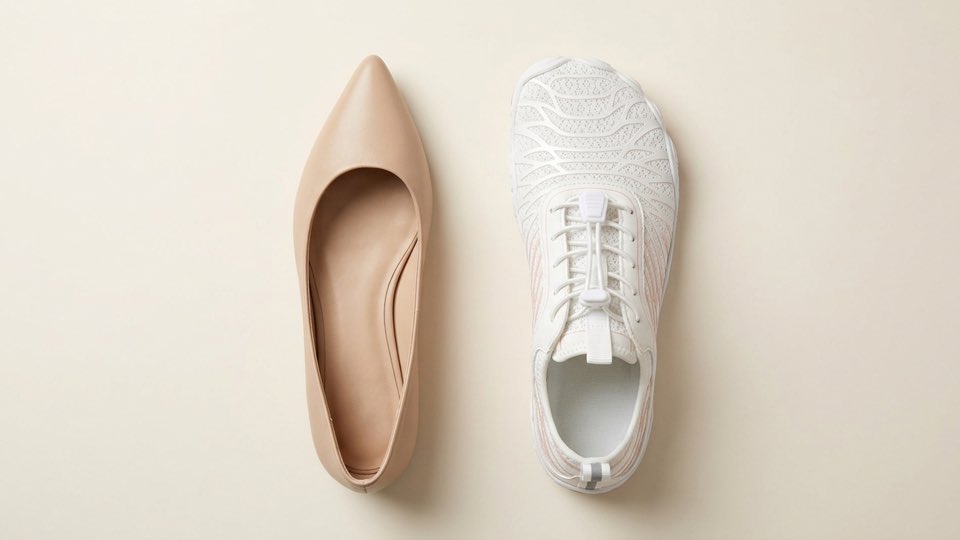
Here is a small test you can do tonight. You need a sheet of paper, a pen, and the shoes you wear most.
Stand on the paper and trace around your foot. Then take the insole out of your shoe (or stand the shoe on the paper and trace around its sole) and lay it over your tracing.
If you are like a lot of women who try this, the result is a small shock: your foot is wider than your shoe, usually right at the toes. The shoe has been squeezing your toes into a shape your foot is not.
It is not your feet. It is the number.
When a shoe pinches, most of us blame our feet, or our age. But there is a simpler explanation, and it has three parts.
1. Your feet changed, your size did not. Feet tend to get wider over the years: in one study of 168 women, the ball of the foot was about 3 to 4 mm wider for every decade of age. Pregnancy can leave many women with longer, wider feet for good. Yet most of us never re-measure. We keep buying the number on our old shoes.
2. Most shoes are pointed. Many shoes narrow at the front, exactly where a foot is widest. So even "your" size presses the toes together.
3. A size is not a measurement. One brand's 8 is another brand's 8½, and almost no shoe tells you how wide it is. So we buy a number and hope.
Researchers keep finding the same thing. In one study of older adults, about 8 in 10 wore shoes narrower than their feet. A review of 18 studies found that 63 % to 72 % of people wore shoes that did not match the width or length of their feet, and poorly fitting shoes went hand in hand with foot pain and foot problems. (Sources at the bottom of this page.)
Most shoes are made to fit a number. Your foot is not a number.
The idea behind foot-first fit
What "foot-first" fit means
Turn it around: start from the foot, then build the shoe. That is the whole idea, and it comes down to three things you can check on any shoe.
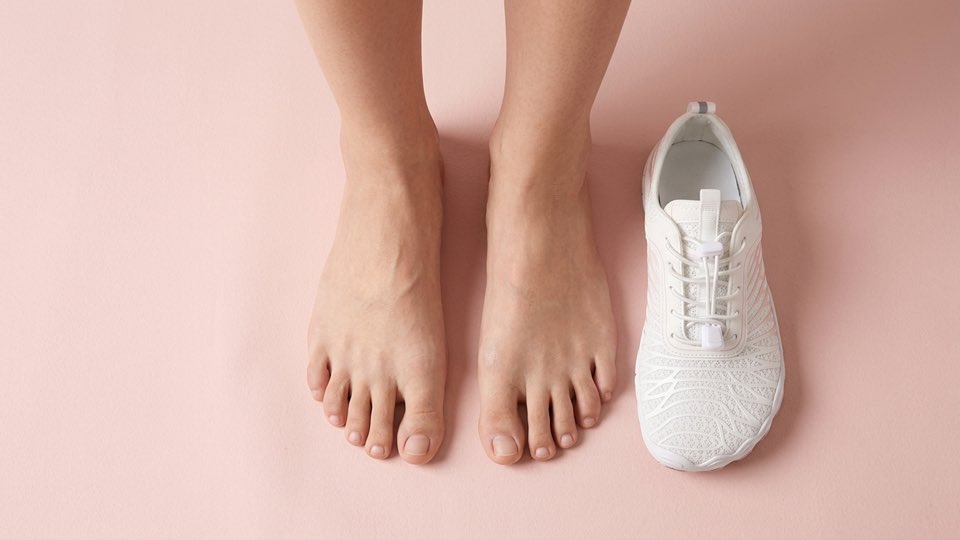
- Sized by your foot, not your number. Measure heel to longest toe (1 minute) and pick the size by that length. Between two sizes, or wide feet? Take the bigger one.
- Shaped like a foot. Widest at the toes, not pointed, so your toes can lie flat and spread out the way they do when you stand barefoot.
- Flat and flexible. Heel and toes at the same height ("zero drop"), and a thin sole that bends with your foot, so you can feel the floor under you.
Why most women never wear shoes like this
Foot-shaped shoes have been around for years. But most of them look like hiking gear, or rubber gloves for your feet, and most comfort shoes in the shops look frumpy. And buying them online is a gamble, because sizes run differently from brand to brand.
So we made one that fixes both: a foot-shaped shoe that looks like a clean white sneaker, sized by foot length from one chart, with a size finder that tells you your size and why.
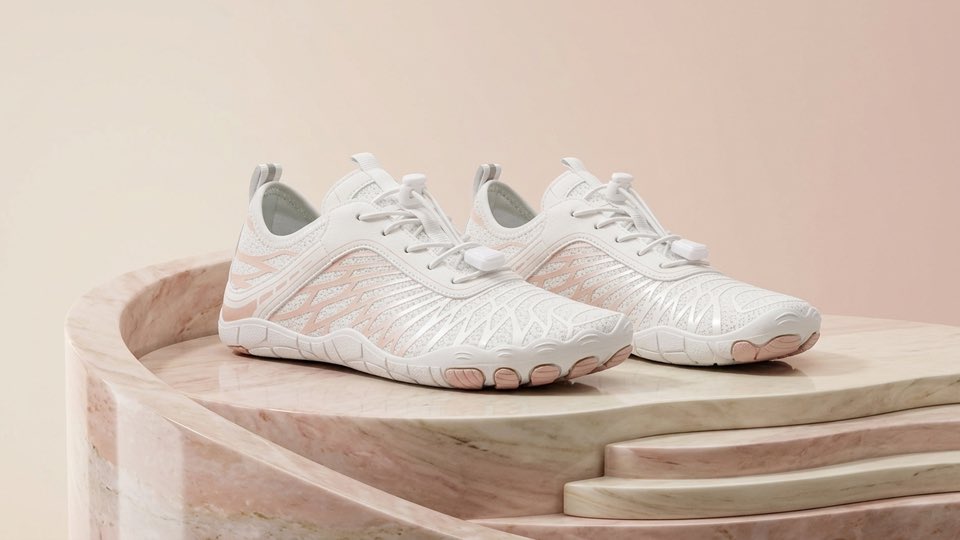
Meet the Mola Everyday
- Wide, foot-shaped toe box
- Flat, thin, flexible sole with a grippy tread
- Breathable knit upper
- Quick toggle laces: pull, slide, go (no knots to tie)
- Soft white and blush: goes with jeans, linen and summer dresses
Use your paper test to get the size right
Keep the tracing you just made. Measure from the back of the heel to the tip of your longest toe: that is your foot length. Do it in the late afternoon or evening (feet are a little bigger by then), standing up, and measure both feet: use the longer one.
Find that length on our size chart. Between two sizes, or wide feet? Take the bigger one. Each size leaves about 1 cm of room in front of your longest toe.
No ruler handy? The size finder asks four quick questions (the sneaker brand you wear, your size, how they fit, how wide your feet are) and picks your size, with the reason. Find my size
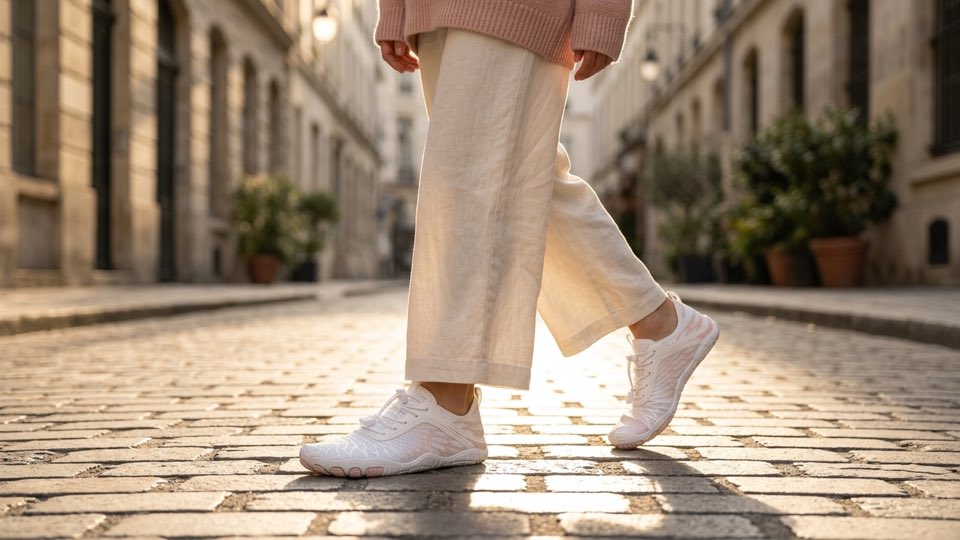
Go slowly for the first few weeks
A flat, thin sole asks your feet and calves to do a little more of the work. So start easy: 20 to 30 minutes a day at home, then short walks, adding a little each week. Most people feel at home in them within two to four weeks. Every order comes with our free Easy Start plan: four simple weeks, one step at a time.
If you have diabetes, neuropathy, poor circulation or any foot condition, talk to your doctor or podiatrist before you switch.
Try them for 30 days
Pick your colour and size. Buying for two? The second pair costs less.
- 1 pair$69.95
- 2 pairs Most popular$59.95 each
- 3 pairs Lowest price a pair$49.95 each
- Easy size exchange
- 30-day fit promise
- Free US shipping over $100
The Mola Right-Fit Starter Set
Try them for 30 days
Pick your colour and size. Most people take 2: one pair for walks, one for home (or one for a friend). Each pair gets its own colour and size.
What you get
- Mola Everyday in white & blush. Foot-shaped toe box, flat flexible sole, breathable knit. From $49.95 a pair in a set of 3.
- Your size by foot length. The 30-second size finder and one chart. Between two sizes? Take the bigger one.Free
- The Easy Start plan. 4 simple weeks to get used to a flat, thin sole. Comes with your order email.Free
- US shipping. Free on 2 pairs or more (1 pair: $6.95).2+ pairs: free
- Right-size promise. Wrong size? The right size for $9.95, nothing to send back. No fee with fit & delivery protection ($4.95 in your cart).
30-day fit promise, in plain words. Try them on at home, on a clean floor. Not for you? Return them unworn within 30 days of delivery for a refund. Return postage is on you: we would rather tell you now than surprise you later.
Every pair gets the set price: 2 pairs $59.95 each, 3 pairs $49.95 each.
- 1 pair$69.95
- 2 pairs Most popular$59.95 each
- 3 pairs Lowest price a pair$49.95 each
- Easy size exchange
- 30-day fit promise
- Free US shipping over $100
Questions
Will these fix my bunion or foot pain?
They are shoes, not a treatment. What they do is give your toes room and keep your foot flat and free to bend. If you have pain, please see a podiatrist.
There is no arch support. Is that a problem?
There is no built-in arch: the sole is flat on purpose. The insole comes out, so you can try your own orthotic if your podiatrist recommends one (many orthotics are made for a raised heel, so ask).
Is a thin sole comfortable on hard floors?
The sole is thin, not bare: it protects you from stones and cold floors. Start with short walks while your feet adjust. If you need a lot of cushioning under your heels (for example after heel pain), these may not be right for you: ask your podiatrist.
How do I pick my size?
By foot length. Between two sizes, or wide feet? Take the bigger one. The size finder does this for you in 30 seconds.
What if they do not fit?
Size exchange: get the right size for a $9.95 exchange fee, no need to send the old pair back. Unworn shoes can also be returned within 30 days of delivery. See returns & exchanges.
Questions
Will these fix my bunion or foot pain?
They are shoes, not a treatment. What they do is give your toes room and keep your foot flat and free to bend. If you have pain, please see a podiatrist.
There is no arch support. Is that a problem?
There is no built-in arch: the sole is flat on purpose. The insole comes out, so you can try your own orthotic if your podiatrist recommends one (many orthotics are made for a raised heel, so ask).
Is a thin sole comfortable on hard floors?
The sole is thin, not bare: it protects you from stones and cold floors. Start with short walks while your feet adjust. If you need a lot of cushioning under your heels (for example after heel pain), these may not be right for you: ask your podiatrist.
How do I pick my size?
By foot length. Between two sizes, or wide feet? Take the bigger one. The size finder does this for you in 30 seconds.
What if they do not fit?
Unworn shoes can be returned within 30 days of delivery. See returns & exchanges.
Choose my size & colour30-day fit promise · Free US shipping on 2 pairs or more
Sources. Shoes vs feet: Buldt AK, Menz HB. Incorrectly fitted footwear, foot pain and foot disorders: a systematic search and narrative review of the literature. J Foot Ankle Res 2018;11:43 (63–72 %). Menz HB, Morris ME, Gerontology 2005 (176 adults aged 62–96: about 8 in 10 in shoes narrower than their feet). Feet change: Ansuategui Echeita J et al., Maturitas 2016 (168 women, ball of the foot 3.1–4.0 mm wider per decade); Segal NA et al., Am J Phys Med Rehabil 2013 (pregnancy). Fit advice: American Academy of Orthopaedic Surgeons, OrthoInfo, Shoes: finding the right fit (room in front of the longest toe, measure late in the day, both feet). Going slowly: Ridge ST et al., Med Sci Sports Exerc 2013.
This is an advertisement by Mola. Mola shoes are not medical devices and are not intended to diagnose, treat or prevent any condition. Study figures describe groups of people in published research, not what any one pair of shoes will do. Individual experiences vary. Talk to a doctor about any foot, balance or nerve problem.